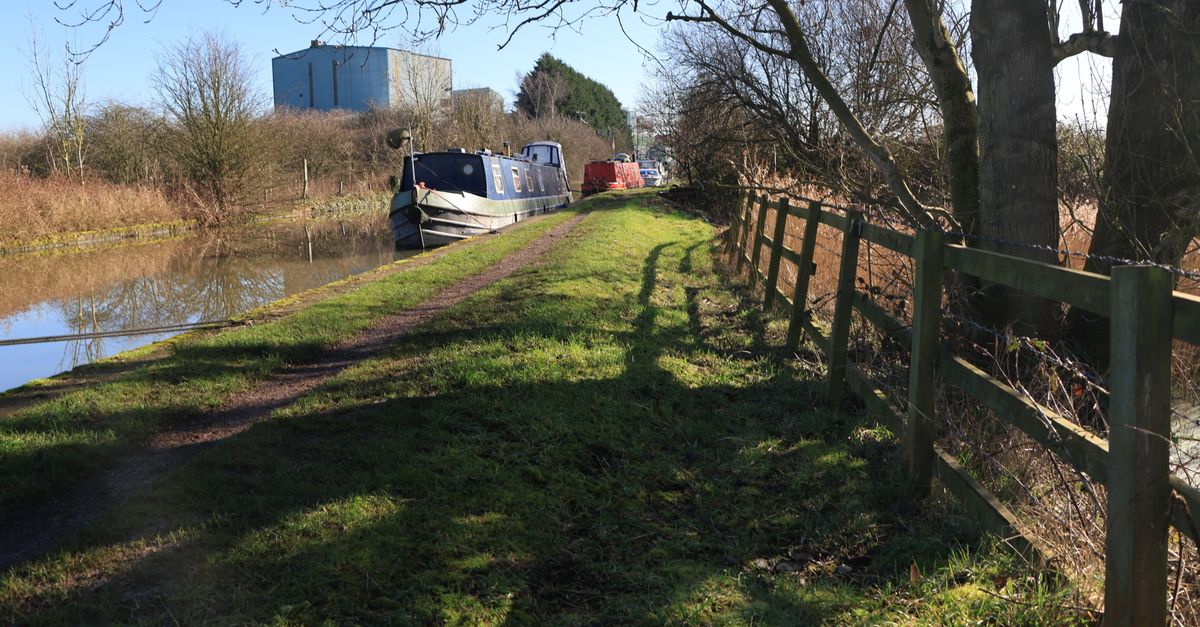
This is the flat walk out of Bath. The Kennet and Avon Canal towpath runs from the city centre out to the village of Bathampton and on to the Dundas Aqueduct, and unlike the Bath Skyline Walk there are no hills to climb, no stiles to cross, and nothing to navigate beyond keeping the water on one side of you. Bath to Bathampton is around 2.5 miles and takes about 45 minutes to an hour at an easy pace, while the full stretch out to the Dundas Aqueduct is roughly 5 to 5.5 miles one way, so most people either walk there and back or turn it into a one-way trip using the bus or train to get home.
The route from Bath to Bathampton
Pick up the towpath near the city centre, close to Pulteney Bridge and Sydney Gardens. The canal actually runs beneath Sydney Gardens itself through two short tunnels, built around 1800 so that boats could pass under the Georgian pleasure garden without spoiling the view from above. From there the towpath heads east under the A36 and out past moored narrowboats, back gardens and allotments, following the canal in a fairly straight, level line towards Bathampton.
You'll reach Bathampton, and the George Inn beside the water, after around 2.5 miles. It's an easy, flat walk the whole way, and the towpath surface on this stretch is well used and generally in good condition, though it can be muddy in wet weather like any canal path.
Continuing on to the Dundas Aqueduct
From Bathampton the towpath carries on past Bathampton Lock and out through quieter countryside towards Limpley Stoke and Monkton Combe. This section adds a further 2.5 to 3 miles before you reach the Dundas Aqueduct, bringing the one-way total from central Bath to around 5 to 5.5 miles.
The Dundas Aqueduct is worth the walk on its own merits. Built by the engineer John Rennie between 1797 and 1805, it carries the canal in a stone channel over both the River Avon and the Bath to Westbury railway line below. It's a Grade I listed structure and was the first canal structure in the country to be scheduled as an ancient monument, and it's also where the Kennet and Avon meets the old, largely disused Somerset Coal Canal. If you want to go further still, the towpath continues on towards Avoncliff and Bradford-on-Avon, covered separately in our day trips from Bath guide.
What you'll see along the way
Expect narrowboats moored two and three deep in places, working boats and holiday hire boats moving through the locks, and plenty of ducks, swans and moorhens on the water. Herons are a regular sight standing at the water's edge. Sydney Gardens at the start gives you a bit of Georgian Bath before the path opens out into greener surroundings, and Bathampton itself is a small, pretty village with St Nicholas' Church next to the towpath. Further out towards Dundas the scenery turns properly rural, with the wooded valley sides of the Avon closing in around the canal.
Practicalities
Where to start
The easiest access point is near Pulteney Bridge or Sydney Gardens, about a 15-minute walk from Bath Spa railway station along Great Pulteney Street. You can also join the towpath at various points further along if you'd rather start closer to Bathampton.
Getting back
For the shorter walk to Bathampton, most people simply turn around and walk back the same flat route. From Bathampton there's also a local bus service (route 11) back into central Bath, and the D1 service, which runs between Bath and Warminster via Bathampton, Winsley and Bradford-on-Avon, also stops there.
If you've walked further, out towards Avoncliff or Freshford, both have small railway stations on the line back to Bath Spa, with the train journey from Avoncliff taking around 12 minutes. Walking there and taking the train back is a popular way to do the longer version of this walk without doubling the distance on foot.
When to go
The towpath is walkable year-round. It's busiest with cyclists, dog walkers and boaters on summer weekends, and can get muddy underfoot after heavy rain, so decent shoes are worth it outside of a dry spell.
| Stage | Distance | Walking time |
|---|---|---|
| Bath city centre to Bathampton | around 2.5 miles | 45 minutes to 1 hour |
| Bathampton to Dundas Aqueduct | around 2.5 to 3 miles | 1 to 1.5 hours |
| Bath city centre to Dundas Aqueduct (one way) | around 5 to 5.5 miles | 2 to 2.5 hours |
If you're short on time or walking with young children, sticking to the Bath to Bathampton leg and back is the easiest way to enjoy the walk. It also pairs well with the ideas in our things to do in Bath guide if you're building a fuller day around it, or see our Bath with kids guide for more family-friendly options nearby. If you're driving in, check our parking guide for where to leave the car before you set off.
Frequently asked questions
Is the towpath suitable for buggies and wheelchairs?
The section between Bath and Bathampton is mostly flat with a compact surface and is generally manageable for buggies and wheelchairs in dry conditions. Further out towards Dundas and beyond, the path narrows in places and the surface becomes rougher, so it's less reliable for wheels the further you go.
Is the walk dog-friendly?
Yes. The towpath is a popular dog walking route, and the George Inn at Bathampton is dog-friendly too, with a canalside beer garden.
Can you cycle the towpath?
Yes, cycling is permitted along this stretch of the Kennet and Avon towpath, and it's shared with walkers, so keep an eye out for cyclists, especially through the narrower tunnels under Sydney Gardens.
Is there a pub stop on the route?
Yes. The George Inn in Bathampton sits right on the towpath, about 45 minutes to an hour's walk from central Bath. It's a canalside pub with a beer garden, popular with walkers, cyclists and boaters, especially in summer.
How long does the whole walk take?
Bath to Bathampton and back is around 5 miles and roughly 1.5 to 2 hours including a stop. Walking one way to the Dundas Aqueduct is around 5 to 5.5 miles and takes about 2 to 2.5 hours, before you factor in the journey back.
Do I need to plan a route or can I just follow the canal?
You can just follow the canal. Keep the water on the same side the whole way and you can't really get lost, which is part of what makes this walk such an easy one for families and first-time visitors to Bath.